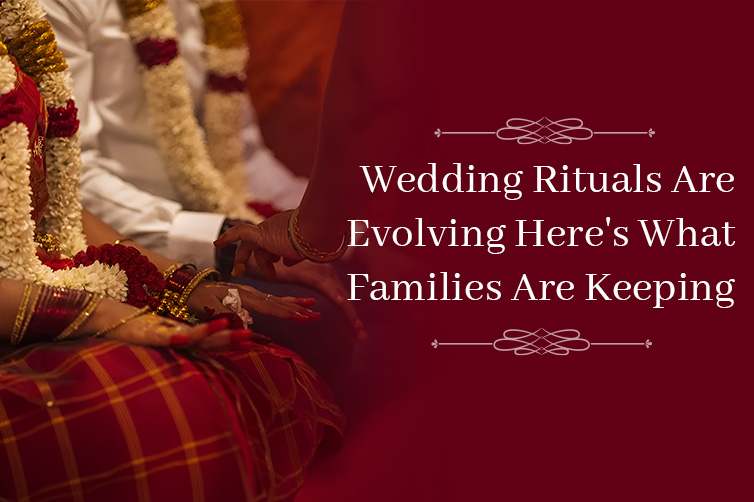
Every family reaches this conversation before a wedding. Someone wants to cut the longer sequences. Someone else says nothing gets removed. The couple is usually in the middle, trying to figure out what the day is actually supposed to feel like. Most families today are not giving up on wedding rituals entirely. They are renegotiating them. If you are searching for a venue near marriage halls in velachery that can hold the full ceremony and seat a large crowd, SGR Mahal in Medavakkam is worth considering. We have been hosting weddings since 2014, and we have watched how indian wedding rituals shift, how families debate them, and how they decide what stays.
The Rituals Families Refuse to Drop
The wedding rituals families consistently hold onto are the ones tied to the ceremony itself. The garland exchange, the tying of the thali, the Saptapadi, the sacred fire. These carry religious and emotional weight that most families consider non-negotiable. Adjustments happen around these rituals, but rarely to them.
Ask any family what actually got cut from the schedule and most will mention the overnight sequences. The third-night ceremonies, the extended post-wedding gatherings that used to run past midnight. The core indian wedding rituals stay. The Kashi Yatra still gets performed. The nalangu still gets its dedicated slot. What changes is the pacing around them, not the wedding rituals themselves.
The art and cultural elements woven into a ceremony’s setting matter more than most families anticipate when they are choosing a venue. Families invest real effort into how the cultural moments look and feel, and that investment tends to protect the rituals themselves. Rituals staged with intention get performed with more of it.
Why Schedules Are Shrinking but Traditions Are Not
Condensed timelines are not the same as diluted traditions. Most Chennai families now work with a one-day or two-day format instead of the older three-to-five-day model. That compression forces real decisions about which wedding rituals get the most time and which get trimmed. What actually happens is prioritization, not elimination. The Muhurtham gets its full attention. The sequences that were always more social than ceremonial are the ones quietly disappearing.
Indian wedding rituals tied to the main ceremony survive even in tight schedules. Families find ways to compress the time without cutting what matters. A good officiant helps. A hall that runs without logistical interruptions helps more. The decoration themes that work around the ceremony rather than pulling attention away from it also play a quiet role in protecting the ritual feel of the day, even when the schedule is tight.
The rituals that get protected are almost always the ones with the clearest meaning. When a family can explain why something happens, they are much more likely to keep it in. That clarity also makes it easier for the officiant to pace things well on the ceremony day itself.
What the Venue Decides Without Your Input
Getting the physical requirements right matters more than most families realize at the venue selection stage. A mandap needs height clearance and a homa needs ventilation. That is before you even factor in whether the ceremony layout gives guests a sight line to the stage. When any one of those is missing, the family ends up simplifying. That is how wedding rituals get lost. Not through intention. Through constraint.
At SGR Mahal, the main hall seats 500 guests with the full venue accommodating up to 1,200. The kitchen handles both South Indian and North Indian catering, which matters when extended families arrive from different regions. The dining hall seats 200 at a time and runs fully air-conditioned, so the meal does not outlast everyone’s patience. When a venue scales to that size, indian wedding rituals that require a large gathering to witness them actually get witnessed properly. That is part of why the right marriage hall shapes the ceremony experience more than most families expect before they book.
Power backup, glass-door elevators, and covered parking for both 2-wheelers and 4-wheelers keep the logistics from becoming the story. When wedding rituals get interrupted by practical failures, the moment passes and does not come back. The ceremony deserves a venue that holds up through all of it.
The New Rituals Families Are Adding
This part surprises people. The older extended sequences are shrinking, but something else is growing. Families are adding wedding rituals that were not standard even a generation ago. The haldi ceremony is now planned months ahead at many Chennai weddings. So is the couple’s choreographed entry and the first-look moment with the family present. These are documented with the same care as inherited indian wedding rituals.
Some of these come from other regional traditions. Some come from what families have seen and decided they want. Either way, they are treated as permanent additions. Indian wedding rituals are not becoming fewer. They are becoming more layered. When you are putting together the full event plan, accounting for both the inherited wedding rituals and the newer additions is what keeps the day from feeling split between two different versions of what it should be.
The additions are not replacing the older ones. They fill the space where the extended overnight sequences used to live. Nobody brought in the haldi ceremony to replace the thali. They brought it in because the schedule opened up room, and it made the day feel more complete.
What Stays Is What Still Means Something
The wedding rituals that carry real weight, the ones that have a reason behind them and connect the couple to the family’s history, are the ones that survive. The ones that were always filler are being quietly dropped, and most families are relieved. For those exploring kovilambakkam marriage halls, SGR Mahal offers the space, the operational depth, and the support to host these moments properly. The ceremony should not have to shrink to fit the venue. Build the ceremony first. Then find the venue that holds it.

